15 Practical AI Agent Use Cases for Modern Businesses
Artificial intelligence is revolutionizing how businesses operate across departments. AI agents—software programs designed to perform specific tasks autonomously—are becoming essential tools for companies looking to streamline operations, enhance customer experiences, and boost revenue. In this comprehensive guide, we’ll explore 15 practical AI agent use cases that businesses of all sizes can implement to gain competitive advantages in today’s digital landscape.
From sales and customer support to marketing and operations, AI agents are transforming traditional business processes with their ability to analyze data, make predictions, and execute tasks with minimal human intervention. These intelligent systems are no longer futuristic concepts but practical solutions addressing real business challenges right now.
AI Agents for Sales
The sales department represents one of the most promising areas for AI agent implementation. AI agents for sales can analyze customer data, predict purchasing behavior, and automate routine tasks, allowing sales teams to focus on relationship-building and closing deals.
Lead Scoring and Qualification
AI agents excel at analyzing vast amounts of prospect data to identify the most promising leads. These systems can evaluate factors like website behavior, email engagement, social media activity, and previous interactions to assign lead scores automatically.
Modern lead scoring AI agents can:
- Analyze thousands of data points in seconds to identify high-value prospects
- Continuously refine scoring criteria based on successful conversions
- Alert sales representatives to hot leads requiring immediate attention
- Reduce time wasted on unqualified prospects
Personalized Product Recommendations
AI agents can analyze customer purchase history, browsing behavior, and preferences to recommend relevant products or services. These recommendation engines significantly increase cross-selling and upselling opportunities.
Effective AI product recommendation agents typically deliver:
- 10-30% increase in average order value
- Personalized suggestions based on individual customer profiles
- Real-time recommendations that adapt to changing behavior patterns
- Improved customer satisfaction through relevant product suggestions
Sales Forecasting
AI agents for sales forecasting analyze historical data, market trends, and sales pipeline information to predict future performance with remarkable accuracy. These forecasts help businesses make informed decisions about inventory, staffing, and financial planning.
AI-powered sales forecasting typically provides:
- 15-25% more accurate predictions than traditional methods
- Early identification of potential shortfalls or opportunities
- Region-specific or product-specific performance projections
- Continuous improvement through machine learning
AI Agents for Support
Customer support operations benefit tremendously from AI agents, which can handle routine inquiries, route complex issues to appropriate human agents, and provide consistent service across all channels. AI agents for support significantly reduce response times while maintaining high service quality.
24/7 Customer Service Chatbots
Chatbots represent one of the most widely adopted AI agent applications. These conversational interfaces can handle customer inquiries around the clock, providing instant responses to common questions and resolving simple issues without human intervention.
Modern AI customer service chatbots can:
- Handle up to 80% of routine customer inquiries
- Seamlessly escalate complex issues to human agents
- Maintain conversation context across multiple interactions
- Provide service in multiple languages simultaneously
Automated Ticketing Systems
AI agents can categorize, prioritize, and route support tickets based on content analysis, urgency, and available resources. These systems ensure that customer issues reach the most qualified agent for resolution in the shortest possible time.
| Benefit | Impact |
| Reduced response time | 30-50% faster ticket resolution |
| Improved resource allocation | Matches tickets to agents with relevant expertise |
| Consistent prioritization | Critical issues never get overlooked |
| Workload balancing | Prevents agent burnout by distributing tickets evenly |
Sentiment Analysis for Customer Interactions
AI agents can analyze customer communications across channels to detect emotion, satisfaction, and potential issues. This sentiment analysis helps businesses identify unhappy customers before they churn and recognize opportunities for service improvements.
AI Agents for Marketing
Marketing departments leverage AI agents to automate campaign management, generate compelling content, and deliver personalized experiences at scale. AI agents for marketing enable precise targeting and efficient resource allocation.
Targeted Ad Campaigns
AI agents excel at analyzing consumer behavior to deliver highly targeted advertisements. These systems can optimize ad spending by focusing resources on the most promising audience segments and automatically adjusting bids based on performance metrics.
Advanced AI ad campaign managers can:
- Automatically optimize ad spending across multiple platforms
- A/B test different creative elements and messaging
- Identify and target look-alike audiences based on existing customers
- Predict campaign performance before launch
Content Generation for Social Media
AI agents can draft social media posts, suggest engaging content ideas, and even create simple graphics based on brand guidelines. These tools help marketing teams maintain consistent social presence without excessive time investment.
Content generation AI agents typically offer:
- Automated post scheduling based on optimal engagement times
- Content recommendations based on trending topics in your industry
- Personalized messaging for different audience segments
- Performance analysis with improvement suggestions
Customer Segmentation and Targeting
AI agents can identify patterns in customer data to create highly specific audience segments. These detailed segments enable precise targeting for marketing campaigns, resulting in higher conversion rates and improved ROI.
Internal AI Agents
Internal AI agents streamline processes within organizations, improving employee experiences and operational efficiency. These AI systems handle administrative tasks, facilitate knowledge sharing, and provide valuable insights for workforce management.
Employee Onboarding Automation
AI agents can guide new hires through the onboarding process, providing customized training resources, answering common questions, and ensuring completion of required documentation. This automation accelerates time-to-productivity for new employees.
Knowledge Management Systems
AI-powered knowledge management systems organize, categorize, and retrieve company information efficiently. These tools make institutional knowledge accessible to everyone in the organization, improving decision-making and reducing duplicate efforts.
Effective knowledge management AI agents can:
- Automatically tag and categorize documents
- Provide intelligent search capabilities across all company resources
- Recommend relevant information based on employee role and current projects
- Identify knowledge gaps that need to be addressed
Performance Monitoring and Feedback
AI agents can track employee performance metrics, identify patterns, and provide actionable feedback. These systems help managers recognize top performers, address productivity issues early, and implement effective improvement strategies.
AI Agents for Operations
Operational efficiency gets a significant boost from AI agents that can optimize processes, predict maintenance needs, and manage resources intelligently. AI agents for operations help businesses minimize costs while maintaining high quality standards.
Supply Chain Optimization
AI agents analyze global supply chain data to identify potential disruptions, optimize shipping routes, and recommend inventory distribution strategies. These systems help businesses maintain operations even during unexpected challenges.
Supply chain AI agents typically provide:
- Early warning of potential supplier issues
- Cost-optimized shipping recommendations
- Demand forecasting to prevent stockouts
- Scenario planning for supply chain disruptions
Inventory Management Automation
AI inventory management agents track stock levels, predict demand patterns, and automate reordering processes. These systems minimize carrying costs while ensuring product availability to meet customer needs.
| Benefit | Impact |
| Reduced carrying costs | 15-25% inventory reduction without stockouts |
| Automated reordering | Eliminates manual purchase order creation |
| Seasonal adjustment | Automatically accounts for seasonal demand patterns |
| Dead stock prevention | Identifies slow-moving inventory before it becomes obsolete |
Predictive Maintenance for Equipment
AI agents monitor equipment performance data to predict potential failures before they occur. This predictive approach allows businesses to schedule maintenance during convenient times, avoiding costly emergency repairs and unplanned downtime.
Resources
To implement AI agents in your business, consider exploring these resources:
- Industry-specific AI agent platforms designed for your particular needs
- AI implementation consultants who can provide guidance on selecting and deploying appropriate solutions
- Open-source AI tools that can be customized to fit your specific requirements
- Case studies of similar businesses that have successfully implemented AI agents
- AI training programs to help your team effectively collaborate with these new digital colleagues
Check this : n8n automation for businesses
Conclusion
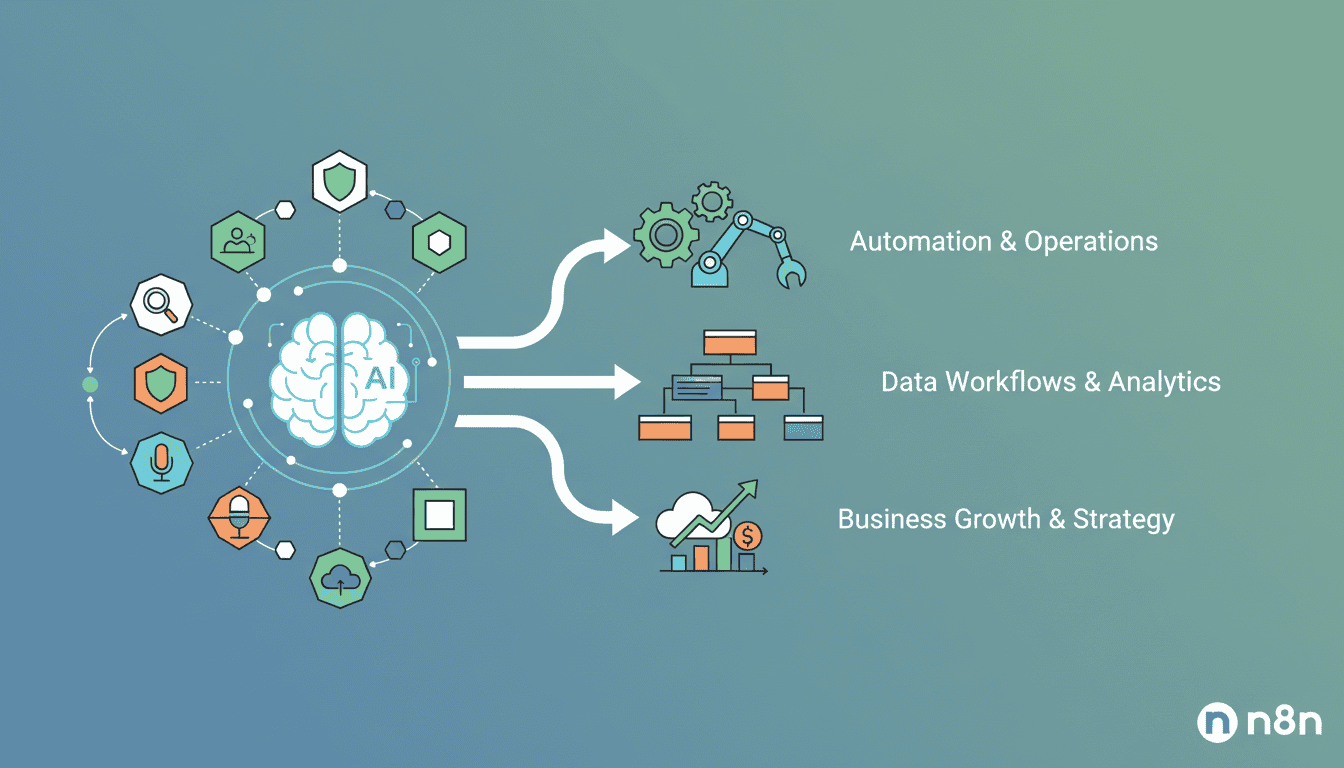
AI agents offer tremendous potential for businesses across all industries and departments. From enhancing customer experiences to streamlining internal operations, these intelligent systems provide practical solutions to common business challenges. The 15 AI agent use cases outlined in this article represent just the beginning of what’s possible. People sometimes prefer to use them separated by tools providers SAAS, and some integrate them in AI automation tools like n8n (check our detailed comparison between these automation tools) or Make.com or Zapier:
As AI technology continues to advance, we can expect even more sophisticated applications that further blur the line between human and machine capabilities. Businesses that embrace AI agents now will build valuable experience and competitive advantages that will serve them well in the increasingly automated future of commerce.
Start small with a single high-impact use case, measure results carefully, and expand your AI agent implementation based on proven success. The key to effective AI agent adoption is focusing on business outcomes rather than technology for its own sake.
Frequently Asked Questions
How do AI agents differ from traditional software?
Unlike traditional software that follows fixed rules, AI agents can learn from data, adapt to new situations, and make decisions with minimal human intervention. They typically employ machine learning techniques to improve performance over time based on experience.
Are AI agents expensive to implement?
Implementation costs vary widely based on complexity and scope. Many AI agent solutions now use subscription models that make advanced capabilities accessible even to small and medium-sized businesses. The ROI typically justifies the investment through labor savings and improved outcomes.
How long does it take to see results from AI agents?
Simple AI agent implementations like chatbots can show immediate results, while more complex systems like predictive maintenance may take several months to gather sufficient data for optimal performance. Most businesses see meaningful improvements within 3-6 months of deployment.
Do AI agents require specialized technical staff?
Many modern AI agent platforms are designed for business users with minimal technical expertise. While data scientists can help optimize advanced implementations, many out-of-the-box solutions require no specialized AI knowledge to deploy and manage.
How do employees typically respond to AI agent implementation?
Employee response varies based on how AI is introduced. The most successful implementations position AI agents as tools that handle routine tasks so employees can focus on more rewarding, creative work. Clear communication about how AI will support (not replace) human workers is essential.
What’s the first step in implementing AI agents in my business?
Start by identifying a specific business problem with clear metrics for improvement. Look for processes that are repetitive, data-intensive, or require consistent 24/7 operation. These areas typically offer the quickest wins and clearest ROI for initial AI agent implementations.