
AI Customer Service Automation: Tools, Use Cases & Setup
In today’s fast-paced business environment, AI customer service automation has transformed from a luxury to a necessity. Organizations seeking to enhance customer satisfaction while reducing operational costs are increasingly turning to artificial intelligence solutions. By implementing AI to automate customer support, businesses can provide 24/7 assistance, reduce response times, and free up human agents to handle more complex issues. This comprehensive guide explores the essential tools, real-world applications, and implementation strategies for effective AI customer service automation.
Essential Tools for AI Customer Service Automation
The foundation of successful customer service automation lies in selecting the right AI tools that align with your business needs. Modern AI solutions offer varying capabilities, from simple chatbots to sophisticated platforms that can understand context, sentiment, and complex queries.
Top AI Tools for Customer Service
When looking to automate customer support with AI, several leading solutions stand out for their effectiveness and ease of implementation:
- Chatbot Platforms: Solutions like Intercom, Drift, and ManyChat provide AI chat for customer service with varying levels of sophistication and customization options.
- Virtual Assistants: More advanced tools like IBM Watson Assistant and Google’s Dialogflow offer natural language processing capabilities that can understand complex customer queries.
- Voice AI Solutions: Platforms such as Amazon Lex and Twilio enable voice-based customer interactions with AI systems.
For smaller operations, customer service bots for small business are increasingly accessible, with options like:
| Tool | Best For | Starting Price |
| Tidio | Small e-commerce businesses | Free plan available |
| MobileMonkey | Facebook and Instagram integration | $119/month |
| Freshchat | Scalable customer messaging | Free plan available |
Integrating AI Helpdesk Automation Solutions
AI helpdesk automation goes beyond simple chatbots by creating comprehensive support ecosystems. Effective integration includes:
- CRM Integration: Connect your AI tools with customer relationship management systems for personalized interactions based on customer history.
- Ticketing System Automation: Implement AI that can categorize, prioritize, and route tickets to the appropriate departments automatically.
- Knowledge Base Connection: Link your AI to your knowledge base to provide accurate information to customers without human intervention.
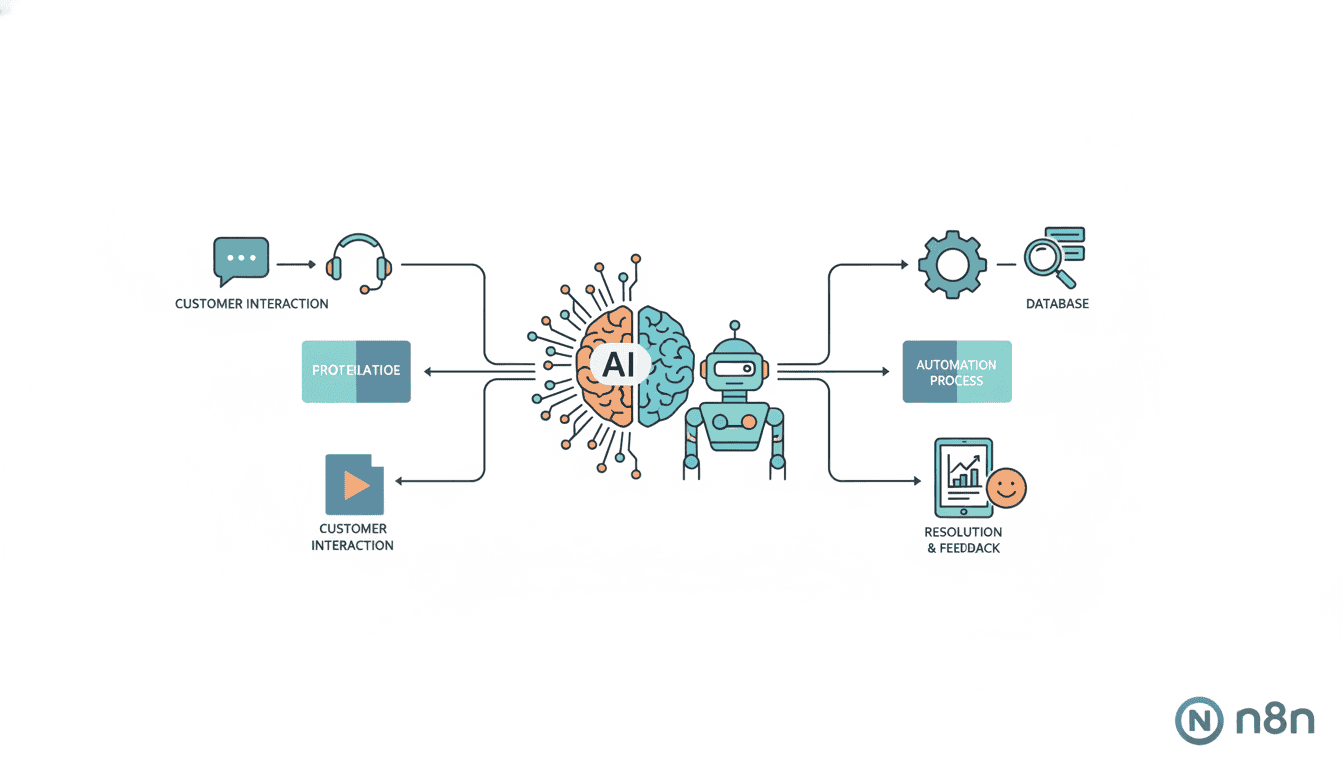
AI support workflows can be designed to handle various scenarios:
- Initial customer contact and information gathering
- Automatic resolution of common issues
- Escalation protocols for complex problems
- Follow-up procedures and satisfaction surveys
Use Cases of AI in Customer Service
AI customer service automation is revolutionizing how businesses interact with their customers across multiple industries. Understanding these applications can help you identify opportunities within your own organization.
AI Chat Solutions for Enhanced Customer Experience
AI chat for customer service has transformed how businesses handle customer inquiries:
- Instant Response: AI chatbots provide immediate responses to customer queries, eliminating wait times.
- 24/7 Availability: Unlike human agents, AI chat solutions operate around the clock, serving customers in different time zones.
- Multilingual Support: Advanced AI systems can communicate in multiple languages, expanding global customer service capabilities.
- Personalization: AI can access customer history to provide tailored responses and recommendations.
Many companies report significant improvements in customer satisfaction after implementing AI chat solutions, with some seeing satisfaction scores increase by up to 25%.
Case Studies: Successful AI Automation Implementation
Examining real-world examples helps understand how businesses effectively automate customer support with AI:
Case Study 1: E-commerce Giant
A major online retailer implemented AI chatbots that handle 70% of customer inquiries automatically. The system resolves shipping questions, processes simple returns, and provides order updates without human intervention. This implementation reduced their customer service costs by 30% while decreasing average response time from 24 hours to under 5 minutes.
Case Study 2: Financial Services
A mid-sized bank deployed AI virtual assistants to handle routine banking inquiries. The system can authenticate users, provide account information, and assist with basic transactions. After implementation, the bank reported a 45% reduction in call center volume and improved customer satisfaction scores.
Case Study 3: Telecommunications
A telecom provider integrated AI into their troubleshooting process. The system guides customers through basic diagnostic steps before escalating to human technicians if necessary. This approach resolved 55% of technical issues without human intervention, reducing field technician dispatches by 25%.
Setting Up AI Customer Service Automation
Implementing AI customer service automation requires careful planning, strategic deployment, and ongoing optimization to achieve maximum benefits.
Step-by-Step Guide to Implementation
Follow these key steps to successfully implement AI helpdesk automation:
- Audit Current Customer Service Processes
- Identify common customer inquiries and pain points
- Map existing customer service workflows
- Determine which processes are suitable for automation
- Select Appropriate AI Solutions
- Evaluate tools based on your specific requirements
- Consider scalability and integration capabilities
- For smaller operations, prioritize customer service bots for small business that offer straightforward setup
- Develop Content and Training Data
- Create comprehensive FAQs and response templates
- Develop conversation flows for common scenarios
- Train the AI system with historical customer interactions
- Implement in Phases
- Start with a limited scope (e.g., one department or simple inquiries)
- Test thoroughly before expanding
- Gradually increase the complexity of automated tasks
- Train Staff and Establish Handoff Protocols
- Ensure human agents understand how to work alongside AI
- Create clear escalation paths for complex issues
- Develop protocols for seamless transitions from AI to human agents
Measuring Success and ROI of AI Automation
To evaluate the effectiveness of your AI support workflows, track these key performance indicators:
- Resolution Rate: Percentage of inquiries successfully resolved by AI without human intervention
- Average Resolution Time: Time taken to resolve customer issues compared to pre-automation metrics
- Customer Satisfaction: CSAT scores for interactions handled by AI vs. human agents
- Cost Savings: Reduction in customer service operational expenses
- Agent Productivity: Improvements in human agent efficiency and ability to handle complex cases
- Containment Rate: Percentage of inquiries fully contained within automated channels
Successful implementations typically see ROI within 6-12 months, with cost savings of 15-30% in customer service operations.
Resources
Recommended Reading and Tools
Expand your knowledge of AI customer service automation with these valuable resources:
- Gartner’s AI in Customer Service Research – Comprehensive analysis of AI trends in customer service
- Harvard Business Review: The Future of Customer Service – Insights on the collaboration between AI and human agents
- HelpScout’s Guide to AI Customer Service – Practical guidance for implementation
Webinars and Online Courses
Further your expertise through educational opportunities:
- Coursera: “AI for Customer Service” certification courses
- LinkedIn Learning: “Implementing Chatbots for Business” courses
- Vendor Webinars: Most major AI customer service providers offer free educational webinars on implementation best practices
- Industry Conferences: Events like Customer Contact Week and AI Summit feature sessions on customer service automation
Conclusion
AI customer service automation represents a significant opportunity for businesses to enhance customer experiences while optimizing operational efficiency. By selecting the right tools, understanding proven use cases, and following a structured implementation approach, organizations of all sizes can successfully leverage AI to transform their customer support operations. As AI technology continues to evolve, the capabilities and applications will only expand, making now the ideal time to begin or advance your automation journey.
Remember that successful automation doesn’t mean eliminating the human element—rather, it’s about creating the perfect balance where AI handles routine inquiries while empowering human agents to provide high-value, empathetic service for complex customer needs. With thoughtful implementation and continuous optimization, AI customer service automation can become a powerful competitive advantage for your business.
Frequently Asked Questions
What are the main benefits of AI customer service automation?
The primary benefits include 24/7 availability, reduced response times, lower operational costs, consistent customer experiences, and freeing human agents to handle complex inquiries that require empathy and critical thinking.
Is AI customer service automation only suitable for large enterprises?
No, there are customer service bots for small business that are affordable and easy to implement. Small and medium-sized businesses can often see faster ROI from AI automation due to immediate efficiency gains.
How long does it take to implement AI customer service automation?
Implementation timelines vary based on complexity, but basic AI chat solutions can be deployed in 4-6 weeks. More comprehensive AI helpdesk automation integrations typically take 3-6 months for full implementation.
Will AI replace human customer service agents?
Rather than replacing human agents, AI typically augments their capabilities by handling routine inquiries, allowing humans to focus on complex issues that require empathy and critical thinking. Most successful implementations create a hybrid model of AI and human support.
What types of customer inquiries work best with AI automation?
Routine, repetitive inquiries with clear answers work best, such as order status checks, account information requests, simple troubleshooting, booking confirmations, and frequently asked questions. Complex issues that require empathy or nuanced understanding still benefit from human handling.
How can we ensure our AI customer service maintains our brand voice?
Most AI platforms allow extensive customization of language, tone, and responses. Creating comprehensive response libraries with content that reflects your brand voice, regularly reviewing AI interactions, and fine-tuning the system based on customer feedback helps maintain brand consistency.